Abstract
This paper investigates using the 5G New Radio Positioning Reference Signal (PRS) as a Sensing Reference Signal (SRS) for radar sensing in Joint Sensing and Communication (JSC) — an ISAC precursor. PRS, designed for in-band wireless positioning, has long Gold-sequence length, rich comb-structured time-frequency resources, and excellent auto-correlation properties that make it superior to other 5G pilot signals (SS, DMRS, CSI-RS) for radar range and velocity estimation. The approach requires no hardware or waveform modifications to 5G NR, making it directly compatible with the 5G-A (Release 18+) deployment. The paper derives Cramér-Rao Lower Bounds (CRLBs) for range, velocity, and positioning estimation, and proposes a multi-frame velocity measurement method. Results feed directly into frame structure design recommendations for 5G-A and 6G sensing reference signal slots.
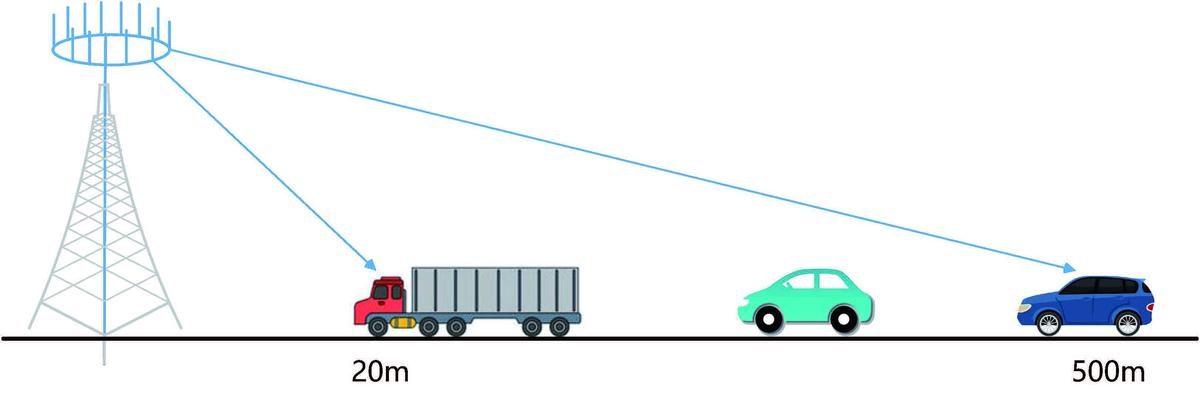 Fig. 1 — JSC roadside base station scenario: downlink PRS transmitted toward vehicle target for simultaneous range/velocity estimation and positioning.
Key Concepts
- Positioning Reference Signal (PRS): A 5G NR downlink pilot defined in 3GPP TS 38.211/38.214, based on length-4096 Gold sequences mapped in a frequency-domain comb structure (Comb 2/4/6/12) across up to 272 PRBs. Originally designed for UE positioning; this paper repurposes it for radar sensing.
- JSC / ISAC Waveform: Communication-centric waveform design where the existing pilot (PRS) simultaneously serves radar sensing. No additional radar-specific waveform required.
- Comb Structure: PRS subcarriers are uniformly spaced in frequency domain (every K_comb subcarriers). The comb size controls the tradeoff between number of PRS subcarriers (sensing performance) and PRB overhead.
- Range Estimation via IFFT: IFFT is applied per OFDM symbol over PRS subcarriers after element-wise division of received by transmitted symbols. The IFFT peak index gives the range.
- Velocity Estimation via FFT: FFT is applied per PRS subcarrier across OFDM symbols. The peak index gives Doppler shift → velocity.
- Ambiguity Function: The PRS ambiguity function is “pushpin type” — high resolution simultaneously in both range and Doppler dimensions, confirming suitability for radar sensing.
- Cramér-Rao Lower Bound (CRLB): Fundamental lower bound on estimation variance. Derived for PRS-based range, velocity, and positioning estimation assuming AWGN.
- Fractional Factor m_a: Increases the number of IFFT/FFT points by factor m_a to reduce estimation error toward CRLB, at the cost of O(m_a·N·log₂(m_a·N)) complexity.
- Multi-Frame Velocity Measurement: PRS from N_f consecutive frames are concatenated to increase effective coherent processing interval, improving velocity resolution while reducing per-frame PRS overhead η_i.
- Sensing Reference Signal (SRS): Proposed signal type for future 5G-A/6G frame structures, dedicated to radar sensing in designated sensing subframes.
Key Equations and Algorithms
- Range resolution: ΔR = c / (2·N·Δf), where N = total subcarriers, Δf = subcarrier spacing.
- Max unambiguous range: R_max = c·N_J / (2·K_comb·Δf), where N_J = N/K_comb is the number of PRS subcarriers.
- Velocity resolution: Δv = c / (2·M·T_s·f_c), where M = PRS symbols per slot, T_s = OFDM symbol duration, f_c = carrier frequency.
- Max unambiguous velocity: v_max = c / (2·K_comb·T_s·f_c).
- Multi-frame velocity resolution: Δv_multi = c / (2·S_J·T_s·f_c), where S_J = total PRS symbols across N_f frames.
- CRLB of range (M,N >> 1): var(R̂) ≥ c²/(8π²·SNR·N_J·N·Δf²)
- CRLB of velocity: var(v̂) ≥ c²/(8π²·SNR·M_J·M·T_s²·f_c²)
- Range-velocity tradeoff: Decreasing T (larger Δf) reduces range CRLB but increases velocity CRLB — they cannot both be minimized simultaneously.
Key Claims and Findings
- PRS outperforms SS and DMRS for radar sensing due to its longer Gold sequence and richer comb time-frequency resources. CSI-RS is excluded from comparison because of its very sparse PRB allocation.
- With fractional factor m_a = 10 and 1000 Monte Carlo runs: range RMSE reduces from 1.17 m → 0.33 m; velocity RMSE reduces from 2.24 m/s → 0.69 m/s (at 24 GHz, µ=3, Comb 4).
- Multi-frame velocity estimation with 3 frames reduces per-frame overhead to 22.9% PRS symbols while achieving ~2 m/s RMSE, with a sensing refresh time of 30 ms (vehicle travels 0.45 m at 54 km/h — acceptable).
- The range-velocity CRLB tradeoff can be navigated by configuring subcarrier spacing µ (0–4) and comb size to meet scenario-specific accuracy requirements.
- Huawei’s 2021 5G-A JSC field test achieved >500 m detection range, validating the practical feasibility of this approach.
Terminology
- PRS (Positioning Reference Signal): 5G NR downlink reference signal defined in TS 38.211, using Gold sequences for in-band positioning. Proposed here as a sensing reference signal.
- Comb-2/4/6/12: PRS frequency-domain patterns where pilots occupy every 2nd/4th/6th/12th subcarrier. Smaller comb = more subcarriers = better sensing performance but higher overhead.
- Sensing subframe / Communication subframe: Proposed 5G-A/6G frame partition: designated slots for radar sensing (carrying SRS) and slots for data transmission.
- Sensing refresh time ρ: Time between successive velocity measurements in multi-frame mode: ρ = N_f · T_f where T_f = 10 ms frame duration.
- PRS symbol overhead η_i: Fraction of symbols per frame allocated to PRS sensing: η_i = S_i / N_slot.
- FRFT (Fractional Fourier Transform): Used with factor m_a to sub-sample the range/Doppler spectrum at finer resolution, approaching CRLB at cost of O(m_a·N·log₂(m_a·N)) complexity.
- JSC (Joint Sensing and Communication): Precursor terminology for ISAC in the 5G-A/6G context; sensing and communication sharing the same signal resources.
Frame Structure Suggestion for 5G-A and 6G
The paper proposes a communication-sensing adjustable frame structure where:
- Sensing subframes carry a dedicated Sensing Reference Signal (SRS) — PRS or a redesigned variant
- Communication subframes carry data, with optional sensing reuse of data symbols in high-demand scenarios
- Comb patterns orthogonalize SRS allocations across base stations to suppress inter-BS interference
- Flexible µ configuration allows trading range vs velocity accuracy per scenario
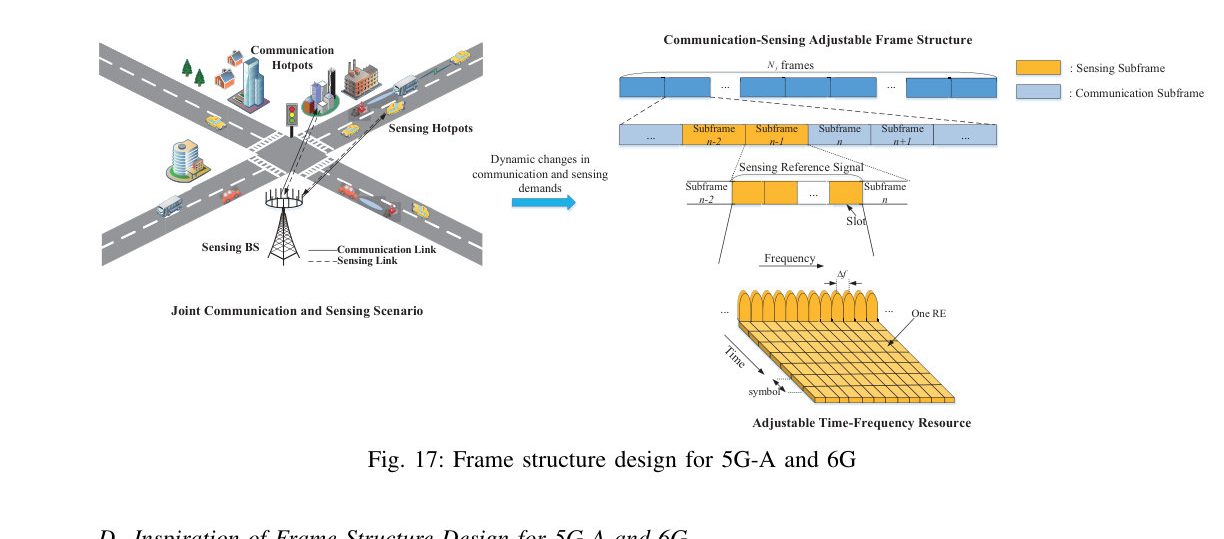 Frame structure design concept for 5G-A and 6G: sensing subframes carry sensing reference signal; communication subframes carry data with optional dual-use.
Connections to Existing Wiki Pages
- 5G PRS-Based Sensing (5G NR angle) — cross-section page covering PRS signal structure detail
- ISAC section index
- 5G NR section index